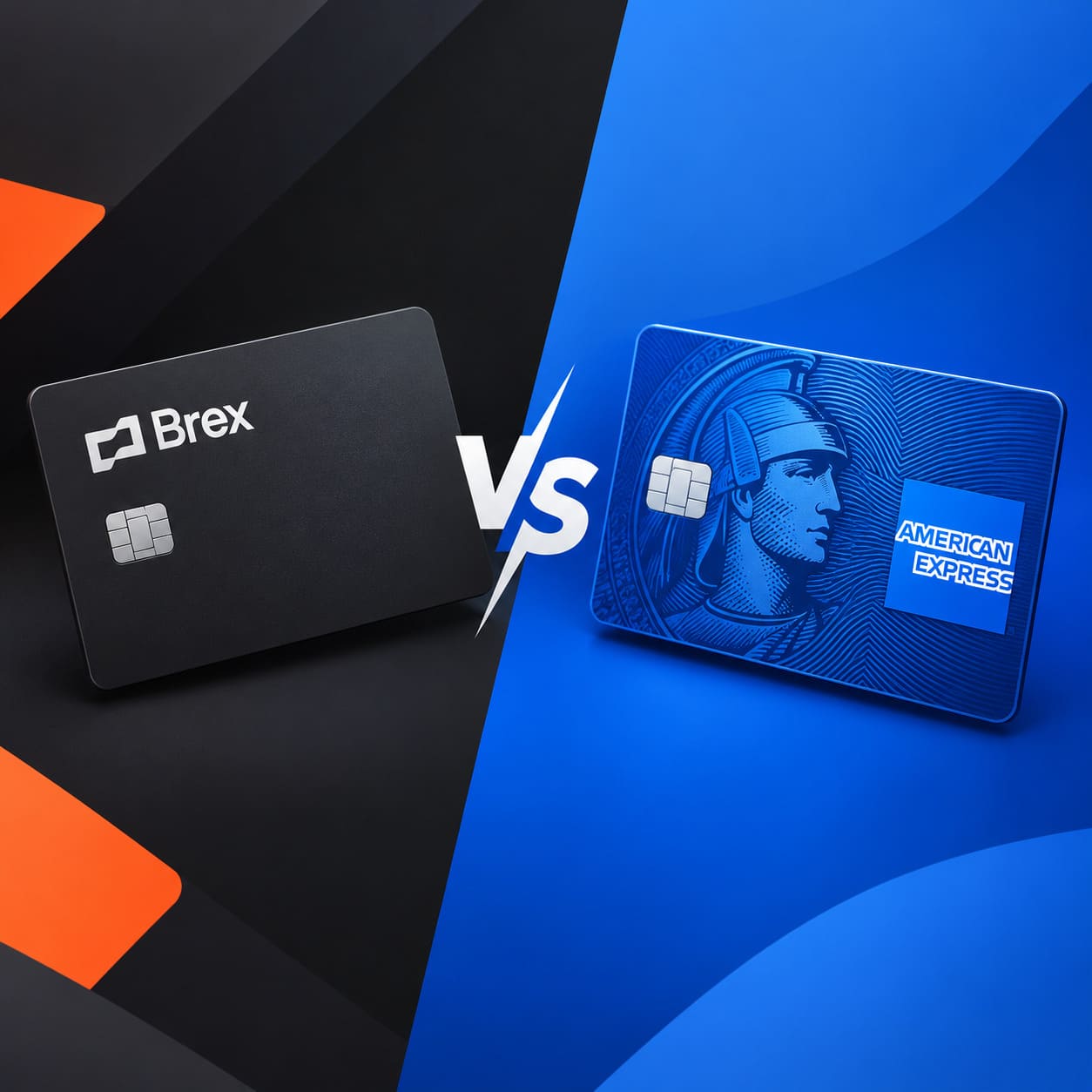
Choosing a business card isn’t always as easy as it sounds. At first glance, you might only compare rewards and fees. But once you look closer, things like employee spending, travel benefits, expense tracking, and payment flexibility can make a big difference.
That’s why the Brex vs Amex comparison is worth looking at.
Brex and American Express take different approaches to business spending. Brex is built around corporate spending and financial management, while Amex has a long-standing range of business and corporate cards with a strong focus on rewards and travel.
So, which one is better?
The honest answer is that it depends on your business. A growing company with a large team may value Brex’s spending controls, while a business that spends heavily on travel may get more from an Amex card and its rewards programme.
Brex vs Amex: Quick Comparison
| Feature | Brex | Amex |
| Main focus | Business spending and financial management | Business and corporate cards |
| Rewards | Brex Rewards | Membership Rewards on eligible cards |
| Expense tools | Strong spending and expense controls | Business and corporate expense tools |
| Employee cards | Employee and virtual cards | Employee or supplementary cards |
| Travel | Travel-related rewards and features | Strong travel-focused benefits |
| Best suited to | Startups and growing companies | Small businesses and established companies |
| Key advantage | Spending control and automation | Rewards and travel benefits |
In simple terms, Brex is more platform-focused, while Amex is more card-focused. That difference can help narrow down the choice.
What Is Brex?
Brex is a financial technology company that provides corporate cards and tools for managing business spending.
What makes it different from a traditional business card is the emphasis on controlling and organising company expenses. Businesses can use features such as virtual cards, spending limits, employee cards, and expense-management tools.
This can be particularly helpful when a company starts growing.
For example, a business might want its marketing team to have one budget, its sales team another, and its finance department a separate spending limit. Having those controls in place can make it easier to keep track of company money.
Brex also offers a rewards programme for eligible businesses, allowing qualifying purchases to earn points.
Who Might Benefit From Brex?
Brex can be worth considering if your company:
- Is growing quickly
- Has several employees making purchases
- Needs tighter control over business spending
- Uses lots of software and online services
- Wants virtual cards
- Wants to automate parts of its expense process
- Needs more visibility over employee spending
For these businesses, the spending-management side of Brex may be just as valuable as the rewards.
What Is American Express?
American Express, or Amex, is one of the best-known providers of business and corporate cards.
Its UK range covers different types of businesses, from entrepreneurs and smaller companies to larger organisations. American Express explains that its business cards are generally aimed at entrepreneurs and small-to-medium-sized businesses, while corporate cards are designed with larger organisations in mind. American Express UK business and corporate cards
One of the biggest reasons businesses choose Amex is its rewards programme.
Eligible cards can earn Membership Rewards points from qualifying purchases. Depending on the product, businesses can also get travel-related benefits and other perks.
That can be especially useful for companies where employees regularly fly, stay in hotels, attend conferences, or travel to meet clients.
Brex vs Amex: Which Offers Better Rewards?
This is where things get interesting.
There isn’t a clear winner because the better rewards programme depends on how your company spends its money.
Brex uses a category-based rewards approach, meaning eligible purchases can earn different amounts depending on the type of spending and the applicable programme terms.
Amex uses Membership Rewards on eligible products. Points can potentially be used for travel, shopping, gift cards, or transfers to participating loyalty programmes, depending on the relevant terms.
You can check the current programme details directly through American Express UK Membership Rewards.
Rather than chasing the highest advertised points figure, look at your own expenses.
If your company spends heavily in categories where Brex offers enhanced rewards, it could be a good fit. If your business spends a lot on travel and can make good use of Membership Rewards, Amex may offer more practical value.
Brex vs Amex: What About Fees?
Fees are another important part of the decision.
Brex has different products and programmes, so the cost and terms can depend on the option available to your business.
Amex also has several business and corporate cards, and annual fees vary between products.
A card with a higher fee isn’t necessarily poor value. If you actually use its travel insurance, airport lounge access, rewards, or other benefits, the extra cost may be worthwhile.
Before applying, compare:
- Annual fees
- Employee-card charges
- Foreign-exchange fees
- Travel costs
- Reward conditions
- Payment terms
- Additional account charges
It’s tempting to pick the card with the lowest fee, but that can be a false economy if you miss out on benefits your business would otherwise use.
Brex vs Amex: Expense Management
For many growing companies, expense management matters just as much as rewards.
Brex puts a lot of emphasis on this area. Businesses can use spending controls and virtual cards to give employees access to company funds without giving everyone the same level of spending freedom.
That can make a difference when a company has multiple departments and recurring expenses.
Amex also has business and corporate expense-management solutions. Businesses can use employee cards and other tools to monitor and manage company spending.
The real question is how much control you need.
If you want a platform built heavily around business spending and financial management, Brex may have an advantage.
If you’re mainly looking for a business card with rewards, employee cards, and established expense tools, Amex may be all you need.
Brex vs Amex: Employee Cards
Employee spending can get messy surprisingly quickly.
One person pays for software. Another books a hotel. Someone else buys lunch for a client. Before long, the finance team is sorting through receipts and trying to match every purchase to the right person or department.
Both Brex and Amex offer employee-card options.
Brex places a strong emphasis on virtual cards and spending controls. This can be useful when different employees or departments need different budgets.
Amex also offers supplementary or employee cards on eligible products.
When comparing them, don’t just ask how many cards you can issue. Think about how easy it is to:
- Set spending limits
- Track purchases
- Freeze cards
- Issue virtual cards
- Collect receipts
- Review expenses
- Monitor department budgets
A good expense system can save a finance team hours of administrative work.
Brex vs Amex: Which Is Better for Travel?
If business travel is a big expense, this deserves special attention.
Brex provides travel-related rewards and features for eligible spending.
Amex, meanwhile, has built a particularly strong reputation for business travel. Depending on the product, Amex business and corporate cards can offer travel rewards, insurance, airport lounge access, and other benefits.
That can be valuable for companies whose employees regularly travel for meetings, conferences, sales trips, or client visits.
Don’t judge a travel card by points alone.
Check the complete package, including:
- Airport lounge access
- Travel insurance
- Hotel benefits
- Airline rewards
- Foreign-exchange charges
- Travel booking options
- Reward transfer partners
- Employee travel controls
The card with the highest points rate isn’t always the one that gives your business the most value.
Is Brex Better for Startups?
Brex can be appealing to startups that want more control over business spending as they grow.
A small finance team may appreciate having spending controls, virtual cards, employee expenses, and financial tools in one place.
That said, Amex can still be a strong option for a startup.
If the main priorities are rewards, travel benefits, employee cards, and a familiar business-card system, an Amex product may be more suitable.
So, it really comes down to what the startup needs today—and what it expects to need as it grows.
Is Amex Better for Small Businesses?
For many small businesses, Amex can be a straightforward choice.
Not every company needs a full financial-management platform. Sometimes, a business simply wants a reliable card that provides useful rewards, employee cards, and travel benefits.
Amex offers several business-card options in the UK, giving smaller businesses different products to choose from.
If your company spends regularly on travel, advertising, meals, hotels, or everyday business expenses, Membership Rewards may add useful value to spending you’re already doing.
Brex vs Amex: Pros and Cons
Brex Pros
- Strong spending controls
- Virtual card options
- Expense-management features
- Designed with growing businesses in mind
- Category-based rewards
- Greater focus on financial automation
Brex Cons
- Product availability and eligibility can vary
- Some smaller businesses may not need all of its features
- Rewards depend on eligible spending and programme terms
- Pricing and conditions should be checked before applying
Amex Pros
- Wide range of business and corporate cards
- Membership Rewards on eligible products
- Strong travel benefits
- Employee-card options
- Established business-card ecosystem
- Products for different business sizes
Amex Cons
- Some premium cards have higher annual fees
- Benefits differ between cards
- Some businesses may not use premium travel perks
- Eligibility varies by product
Brex vs Amex: Which Business Card Should You Choose?
There’s no universal winner.
Brex may be the better choice if your priority is controlling company spending, managing employee expenses, using virtual cards, and bringing more financial processes together.
Amex may be the better choice if you care more about Membership Rewards, travel benefits, employee cards, and having a range of established business-card products to choose from.
For a News paper article comparing the two, the key point is simple: don’t choose based on the brand name alone.
Think about how your business actually spends money.
If most of your expenses are software, subscriptions, employee purchases, and controlled departmental spending, Brex could make more sense. If travel and rewards are a major part of your expenses, an Amex product could be the better fit.
Frequently Asked Questions
Is Brex better than Amex?
It depends on your business. Brex may be more suitable for companies that want detailed spending controls and integrated expense-management features. Amex may be a better fit for businesses that value rewards and travel benefits.
Is Amex good for business travel?
Yes. Certain Amex business and corporate cards provide travel-related rewards and benefits. The exact features depend on the card.
Which is better for startups, Brex or Amex?
Brex can suit startups that need stronger spending controls and financial-management tools. Amex may be better for startups that mainly want rewards, travel perks, and employee cards.
Does Amex offer business rewards in the UK?
Yes. Eligible UK business and corporate cards can earn Membership Rewards points. The earning rate and conditions depend on the specific card.
Can employees have Amex business cards?
Yes. Eligible Amex business products can provide supplementary or employee cards, allowing employees to make business purchases through the company’s account.
What should I compare before choosing a business card?
Look at the annual fee, rewards, spending categories, travel benefits, employee-card costs, foreign-exchange charges, expense-management features, payment terms, and eligibility requirements.
Final Verdict
So, Brex vs Amex—which business card is better?
If your company is growing quickly and needs stronger spending controls and expense-management tools, Brex may be the better fit.
If your business places more importance on Membership Rewards, travel benefits, employee cards, and a wider choice of business-card products, Amex may be the stronger option.
At the end of the day, the best card isn’t necessarily the one with the biggest rewards headline.
It’s the one that fits the way your company actually operates.
Take a close look at your monthly spending, work out which benefits you’ll genuinely use, compare the fees, and then make the call. That’s a much better way to choose a business card than simply picking the most popular name. Read more: CIT Bank Application